

Can a Showing Agreement Cover a Large Territory?
If a buyer and brokerage firm want to use a Showing Agreement to cover a large territory instead of a list of properties, what concerns does this raise?
ORLANDO, Fla. — Can a buyer and brokerage firm use a Florida Realtors® Showing Agreement (SA) form but, instead of listing specific properties, use it to describe a territory like a county or region?
The easy first answer is of course they can. All contracts are negotiable, and parties can modify form language as they see fit. It would likely be an enforceable contract as well if the parties had to go to court. This article is simply a best practice recommendation about how to use the forms as written. Another option that I would include as a clear best practice is to have a lawyer draft any modifications the parties or a brokerage firm want to make to form language.
However, since the form is written so that the properties should already be identified in a list, not a search area, using a territory could lead to unexpected pitfalls if the SA faced the scrutiny of a civil case or other formal hearing, and it may not be suited to the relationship the parties expected to have.
Property description
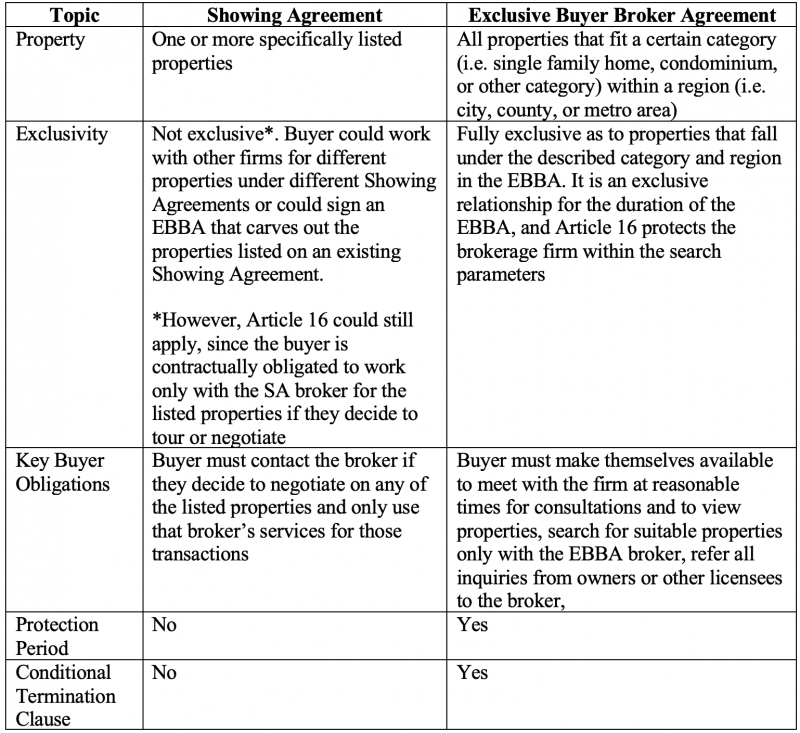
Section 2 of the SA, titled Property, consists of 7 blank lines that are introduced as “This Agreement applies to the following properties:” It’s asking for one or more specific properties, usually listed by mailing address, although legal descriptions would work as well. Since the properties are already identified, there’s no need to search for suitable properties. You could say that those are your properties, but that is not your buyer for anything outside of those properties.
This is different from an Exclusive Buyer Broker Agreement (EBBA), which describes a relationship between the buyer and brokerage firm. They will embark on a search of suitable properties that match the type of property (i.e., single family home) within a territory (i.e., metro area). You could say that is your buyer for the duration of the EBBA.
So, if you change a SA to cover a territory, it’s like an EBBA. But it’s missing a lot of the language that focuses on the relationship and the search for suitable properties.
Here are some more examples that show why the best practice is to use a SA for properties and an EBBA for a territory:
Exclusivity
The SA doesn’t use the word exclusive anywhere in the agreement. It also doesn’t reference any language from Article 16 of the NAR Code of Ethics. If a buyer wanted to sign multiple SAs with different companies for different properties, they could. They could also sign an EBBA with a different brokerage firm that carves out the property(ies) listed in the SA. The only obligation a buyer has when talking with other licensees is to let them know they have “contracted with Broker with regard to the properties listed above.”
Despite this lack of explicit exclusivity, please note that Realtors® could still face NAR Code of Ethics liability under Article 16 if they tour or negotiate properties already covered by another brokerage firm’s SA. While it may not be their buyer, those are their firm’s properties.
Under an EBBA, the relationship between the buyer and brokerage firm is exclusive. It’s a central part of the agreement, and the very first words of the agreement are “Consumer grants Broker the exclusive right to work with and assist Consumer in locating and negotiating the acquisition of suitable real property as described below.” Unlike a SA, the EBBA places strong limits around interaction with licensees, including a buyer obligation to advise an owner or licensee that they are “working with and exclusively represented by Broker.”
Buyer obligations
Under a SA, the buyer isn’t technically obligated to do anything regarding the listed properties until and unless they decide to move forward on a given transaction. The buyer is obligated to “Immediately contact Broker upon deciding to negotiate for the acquisition of one or more of the above-listed properties.” Additionally, the contract begins “If...Consumer becomes interested in touring, negotiating the purchase, option, exchange, lease or other acquisition of any of the properties listed below, Consumer will utilize the professional services of [brokerage firm].”
An EBBA creates buyer obligations upon signing. The main obligation provides that a buyer must “Conduct all negotiations and efforts to locate suitable property only through Broker and refer to Broker any inquiries of any kind from real estate licensees, property owners, or any other source.” Another obligation that exists in the EBBA, but not the SA, highlights that searching for suitable properties is a key component: the buyer must be “available to meet with Broker at reasonable times for consultations and to view properties.”
Broker obligations
Under a SA, the broker is essentially on call. They aren’t obligated to provide services until and unless the buyer decides to move forward. “If Consumer wants to negotiate a transaction on any of the above properties, Broker will use Broker’s professional knowledge and skills; use diligent effort to show Consumer the above-described properties; assist Consumer in negotiating and closing any resulting transaction; and cooperate with real estate licensees working with the owner, if any, to complete a transaction.”
EBBA obligations exist as soon as the contract is signed. The EBBA covers the same territory as the SA but also provides that the broker will work with the buyer to discuss their property requirements and will help them locate and view suitable properties.
Closing thoughts
If you have a SA, those are your properties, and you will help the buyer tour and negotiate them if they decide to move forward on any of them. If you have an EBBA, that’s your buyer, and you will work together to locate and negotiate suitable properties within a territory.
While brokers and buyers are welcome to deviate from that plan any time they like, they would be well advised to have a lawyer help if they want to change something substantial, like changing a list of properties into a territory.
Joel Maxson is Associate General Counsel for Florida Realtors
Note: Information deemed accurate on date of publication
© 2026 Florida Realtors®