

Florida’s migration advantage is changing — but income still flows in
Total population growth misses the nuance of who is moving and how much money they bring with them.
High-profile relocations may grab headlines, but Florida's migration story extends far beyond billionaires and corporate executives.
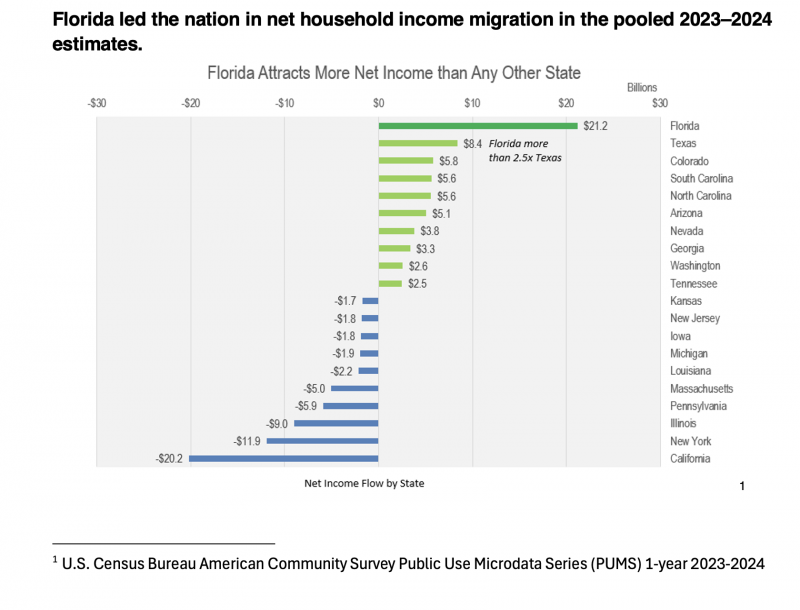
The income associated with households moving to Florida reflects a much broader population of new residents, including working professionals, families and retirees. Understanding that income movement offers another perspective on Florida's changing population and economy. Florida still leads the nation in net household income migration, but both migration and income gains have slowed from their pandemic peaks.
For Realtors®, the number of people moving to Florida tells only part of the story. Their incomes also help shape demand for homes and local businesses. Even with fewer people moving here, higher-income households can support home sales and spending at stores, restaurants and other businesses.
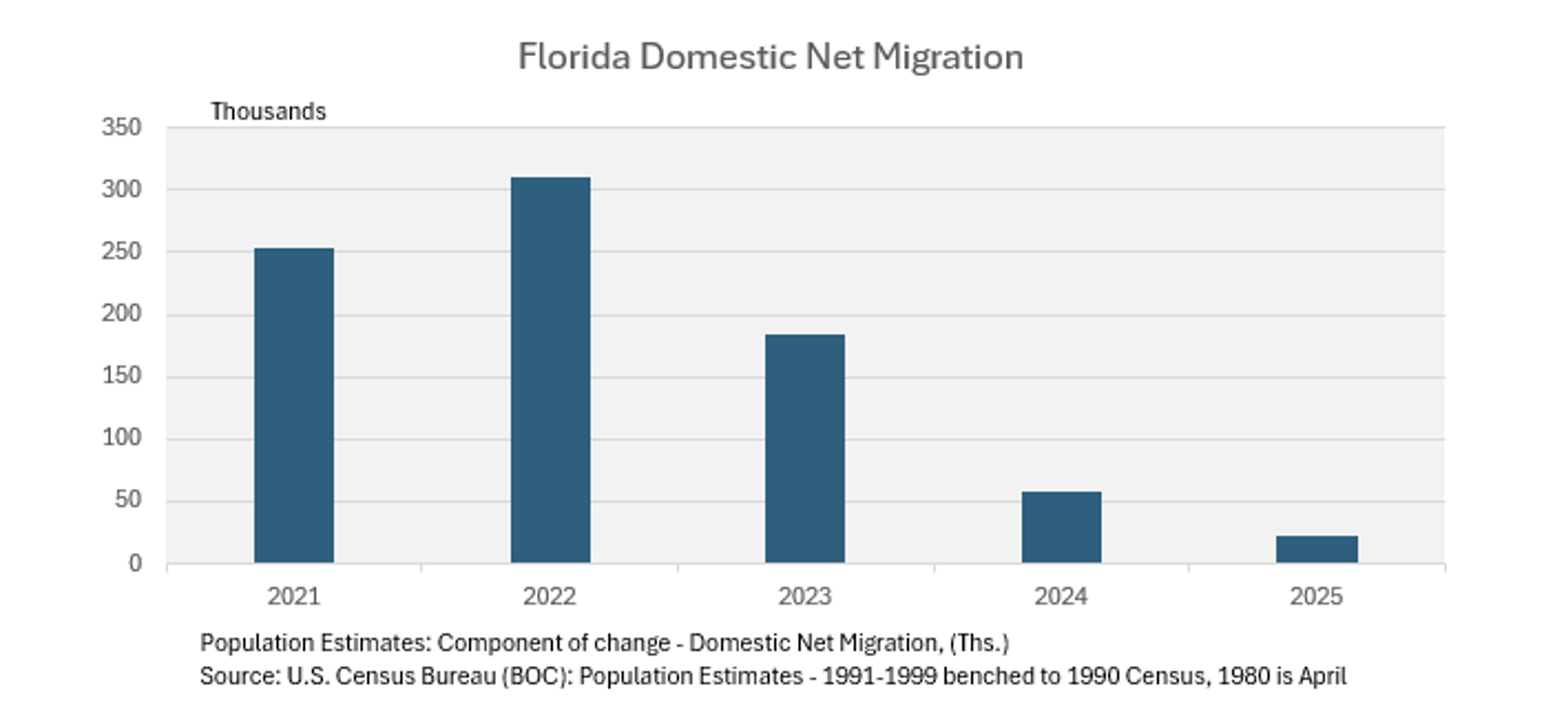
Florida’s Net Domestic Migration Peaked in 2022
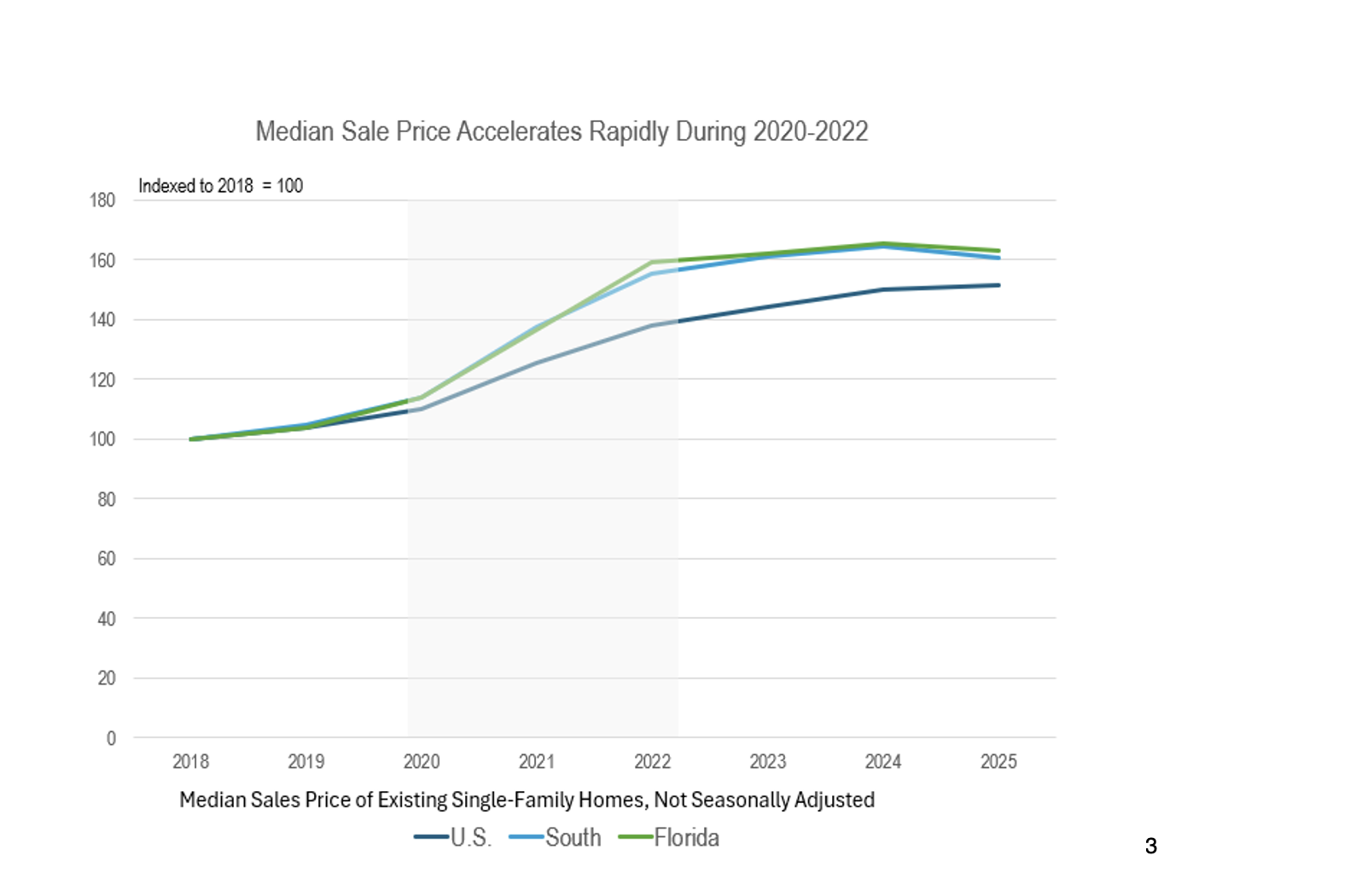
Florida’s net domestic migration (22,517 in 2025) was down sharply from 2023 (183,646) and 2022 (310,892). While Florida has often ranked at or near the top state for net domestic migration, in 2025, it ranked 8th. This aligns with the rapid increase in median sale price beginning in 2020[2].
These figures reflect net domestic migration, or the difference between residents moving to Florida from other s states and those leaving Florida for another state. Florida's total population continued to grow during this period, supported by international migration even as deaths outnumbered births.
Increasing prices in the South, especially Florida, made moving to Florida more difficult, particularly when mortgage rates began to rise in earnest in the back half of 2022. For people moving to Florida, the home price is only part of the cost. Insurance, property taxes and association fees also affect what they can afford. Realtors can help customers understand those expenses early, especially if they’re used to paying less where they live now. As median sale prices rose coming out of the pandemic era nationally, the level was much higher in the south and Florida specifically.
Note: Movers can be intra-state and focus on domestic migration (excludes international)
Source: U.S. Census Bureau American Community Survey Public Use Microdata Series (PUMS) 1-year 2023-2024
[2] National Association of REALTORS ® Research, Florida REALTORS ® Research
[3] National Association of REALTORS ® Research, Florida REALTORS ® Research
Income Migration Has Been Declining Along with Overall Migration
Net income migration peaked in 2022 with $14.6 billion, compared with 2024 which had $8.6 billion, representing a 41% decline. Although the total household income associated with people moving into Florida continued to increase, the income associated with departing households grew even faster, narrowing the state's net income gain.
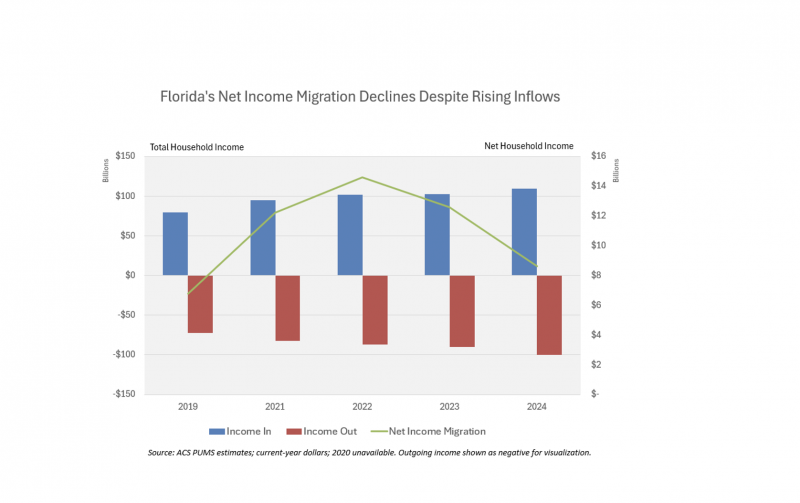
The smaller net gain doesn’t mean incoming households brought less total income. More income was also leaving. Both sides matter for real estate: arriving households need somewhere to live, while departing homeowners may have a home to sell.
Income also doesn’t tell us everything about a household’s buying power. Savings, debt and equity from a previous home sale can make a difference in what a customer can afford.
Florida Maintains Its Lead as Other States Also Slow
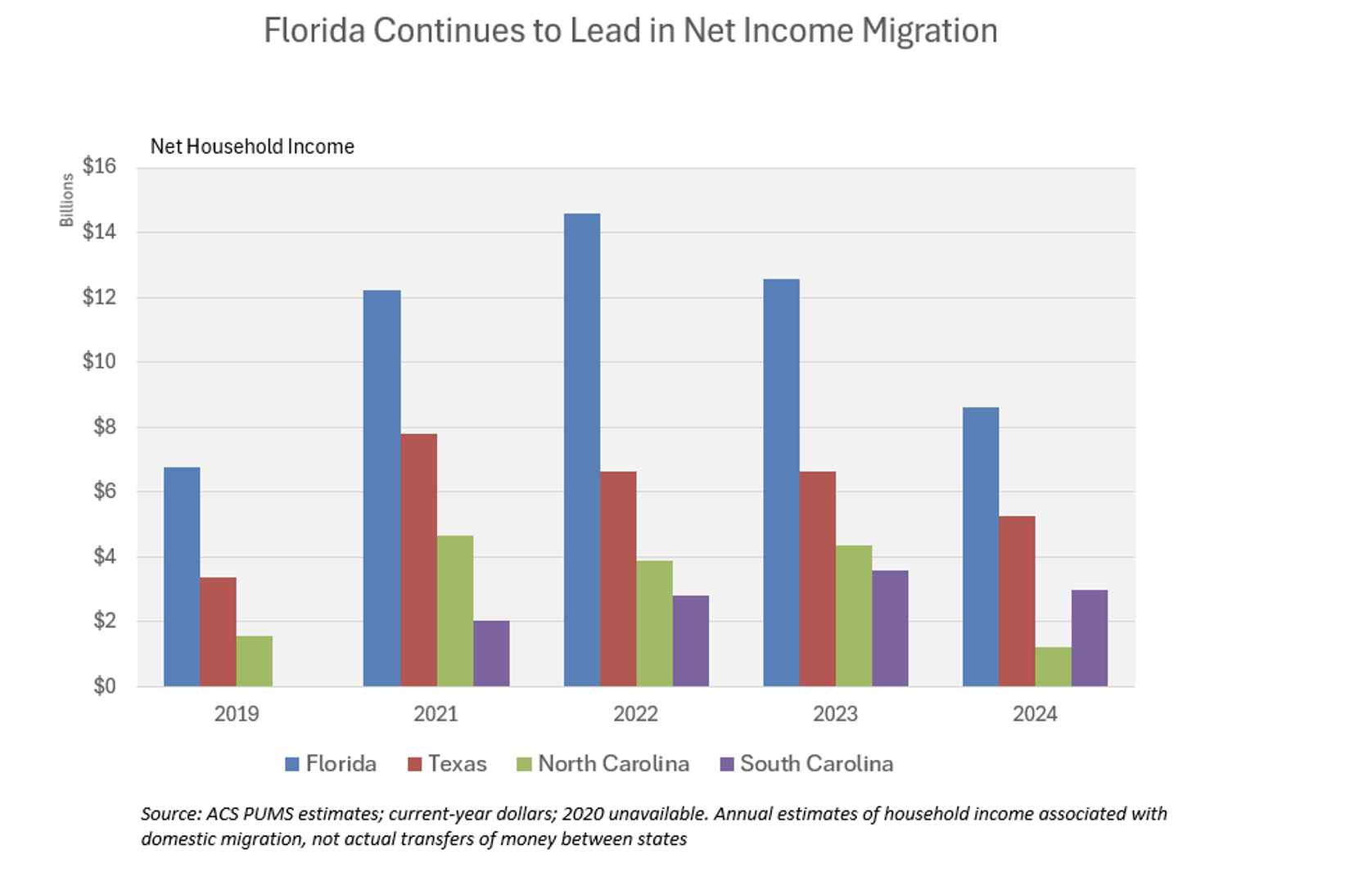
Pulling back and putting Florida into regional context, the phenomenon of income leaving typically high-growth states and thus weighing down net income is not unique to Florida. And while it looks like there was a lot of income leaving Florida, this was also the case in our competing states. Florida still leads with the highest net income migration in the country. The one state to watch is South Carolina, which demonstrated resiliency during this time.
That competition may already be coming up in conversations with relocating customers. For someone weighing Florida against another state, a comparison of housing options and ongoing ownership costs can help them decide where their budget works best.
Mo’ Money, Mo’ Problems?
There’s a lot to unpack with this, but the main thing to recognize is Florida’s demographic changes and their potential implications on all forms of real estate.
On the residential side, we’re starting to see a divergence in the marketplace. People with higher incomes and less reliance on levered capital (loans) are able to more comfortably transact in today’s environment, as evidenced by increased activity among higher price tiers. Even when median sales prices hold steady overall and closed sales decline, increasing dollar volume can point to the role higher end sales are having on the market overall.
That distinction can help Realtors explain why a market can look different from one price range to the next. Higher-end sales can boost overall dollar volume even as buyers with smaller budgets struggle to afford a home. When talking with sellers about pricing, bring it back to what’s selling in their neighborhood and price range. More income moving into Florida doesn’t mean more buyers for every home.
People more vulnerable to even slight changes in mortgage interest rates can be knocked out of the buyer pool, while higher sale prices push the amount needed for a down payment further up, dipping into already constrained budgets. For those customers, revisiting the price range, home size or location with current financing estimates may help establish which options remain within reach.
On the commercial side, demand for consumer goods follows those with higher discretionary spending in their budgets, which may show up in strong leasing and new construction.
Where those households settle matters, too. Their spending can support nearby stores, restaurants and services, but the effect will vary by community. Commercial Realtors can use local population and income trends alongside vacancies, rents and business activity to help customers assess a location. Florida’s statewide gains provide context; a closer look at the community helps show where demand may support a business or property.
While Florida’s migration advantage has moderated, we still are experiencing substantial net household income gains – implications of which extend beyond just the total number of people moving here.
Jennifer Warner is the Director of Economic Development and Commercial Research
© 2026 Florida Realtors®