

Florida’s Migration Is Cooling, Not Reversing
Florida’s migration has slowed from its pandemic peak as affordability reshapes who moves in and out, especially younger workers, families and retirees.
Florida’s domestic migration story has become a bit messy and nuanced in the years since the pandemic as Florida went through a seismic shift in that time, leaving today’s Florida in a much different place than it was in 2019.
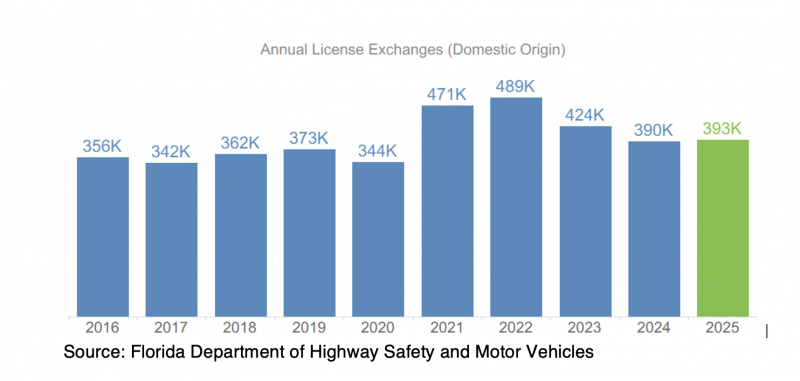
There are several data sources we look at when trying to figure out who’s moving to and from Florida. The data we look at for timely, though less detailed, proxy for migration is from driver’s license exchanges, published by the Florida Department of Highway Safety and Motor Vehicles. This helps tell an overall migration story, filling in the gaps while we wait for data from the U.S. Census Bureau, which is more accurate and comprehensive though lagged.
Both data sets indicate that domestic migration into Florida has slowed and there have been fewer people moving into Florida since the peak in 2022. Still, according to the driver’s license exchange data, in-migration exceeds levels observed prior to the pandemic. In 2025, license exchanges were about 393,000. This is nearly equal to 2024, which was the lowest year for license exchanges in Florida since peaking in 2022. That is still well above the pre-pandemic average of about 358,000 licenses. More importantly, we were one of the few states that had such a strong migration story in 2021-22. That created some momentum that helped sustain Florida’s appeal, and pricing, in the years ahead.
Beyond Totals, Age Segments Matter
Moving now to the gold standard is the latest from the U.S. Census Bureau 2024 American Community Survey (ACS) data that dropped recently. While lagged, as we’re just getting information about 2024 over a year later, this is the official story of domestic movers in and out of Florida.
What’s happening among age cohorts is where the story gets interesting. The data has potential for understanding where we are today and where Florida may be heading in the future. What we get here is the ability to look at different age groups that the totals in the driver’s license data doesn’t show.
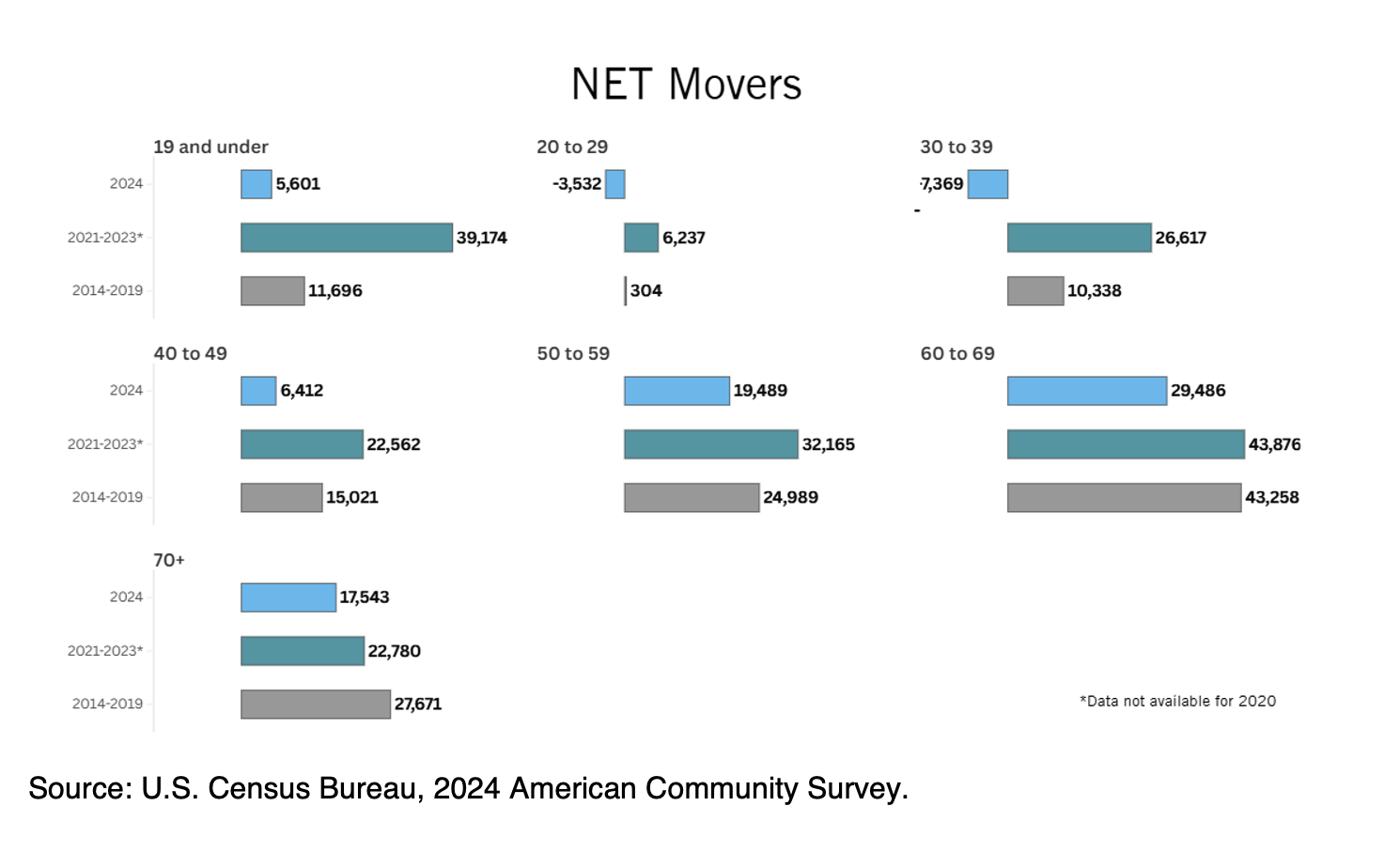
To contextualize how we’re looking at different periods of time, we’re going to look at net domestic movers (total in-migration less total out-migration) over three defined periods of time. First is 2014-19, which is a more typical time in Florida’s history. Then we’re looking at 2021-2023, which includes the peak years of in-migration along with the first year when this started to slow. Finally, we’ll compare that to 2024 – the latest year of data to put today’s numbers into context.
Young Adults on the Move and Why It Matters
Let’s start with the 20-29 age cohort, which amounts to our younger workforce and potential feeder into the overall workforce as they age. This is a very mobile group, with typically as many people moving out as they are moving in. Historically, their net migration is almost nothing. This trend shifted, however, during the pandemic recovery years, with more people in this age group coming in than they were moving out. This was a novel period that excited many economic development professionals, hoping this meant a stronger, younger workforce that would take on entry level jobs. This trend, however, began to reverse in 2024 with more people in this age cohort moving out of Florida. Affordability is often a strong factor at play with people in this stage of life as they are transitioning out of college or vocational training and entering the workforce. Ensuring a stable path into adulthood is key to keeping people here, which also includes affordability of housing and childcare.
Housing Costs Reshape Young Family Migration
Two other age groups have seen shifts in 2024 that are likely related to one another, and that is the 19 and under group and the 30-39 group. Ostensibly, these are parents and their young children, based on when Americans are typically entering into parenthood. Both groups saw a strong uptick in 2021-2023, indicating that a lot of families with young kids were moving into Florida. Keep in mind these are not children that were born in Florida during this time but moved to the state from another part of the country. This speaks to the progress Florida has made in attracting families with children who are comfortable engaging in our public and private school system. However, this trend is also looking to slow down in 2026, where young families are finding it harder to enter Florida’s housing market as affordability has thwarted the ability for younger people to buy homes. Since the median age for a first-time home buyer has shifted up to 40 years old nationally according to the National Association of Realtors 2025 Profile of Home Buyers and Sellers, it’s understandable that Florida’s appeal for young families and their children may have waned. Still, others may want to be here but can’t make it work, alluding to a lot of unrealized demand that is shifting to other lower cost areas in the country.
Finally, with overall migration down, it’s understandable that we’re observing lower net migration among the largest group – the retirees. While still strong, this group is seeing lower numbers in 2024 than was typical in years prior. This also potentially speaks to the affordability issue that is weighing on younger people and families. Even for those older people who are fortunate enough to own their homes outright, rising insurance, property tax and potentially special assessments can tip the balance. Often on a fixed income, people in this stage of life may be more vulnerable to rising costs than those at the earlier end of their earning potential.
Takeaways
The reality is Florida’s economy is maturing, and with that comes affordability challenges. Many of these are not unique to Florida – other parts of the country are dealing with insurance woes, rising home prices and overall increases in everything from groceries to cars. The parts that are unique, including high insurance rates, special assessments in accordance with increased condo regulation and a higher percentage of older people on a fixed income, present specific challenges. Still, a maturing economy also brings a wider array of employment opportunities in various industries for different ages and skill and education levels. And people still like living near the beach.
Jennifer Warner is an economist and Director of Economic Development
© 2026 Florida Realtors®